Digital Marketing
Your WhatsApp replies now cost money
WhatsApp service replies stopped being free when Meta moved to per-message pricing on 1 July 2025. Here is what changed, and the 1,000-message free tier.
In short
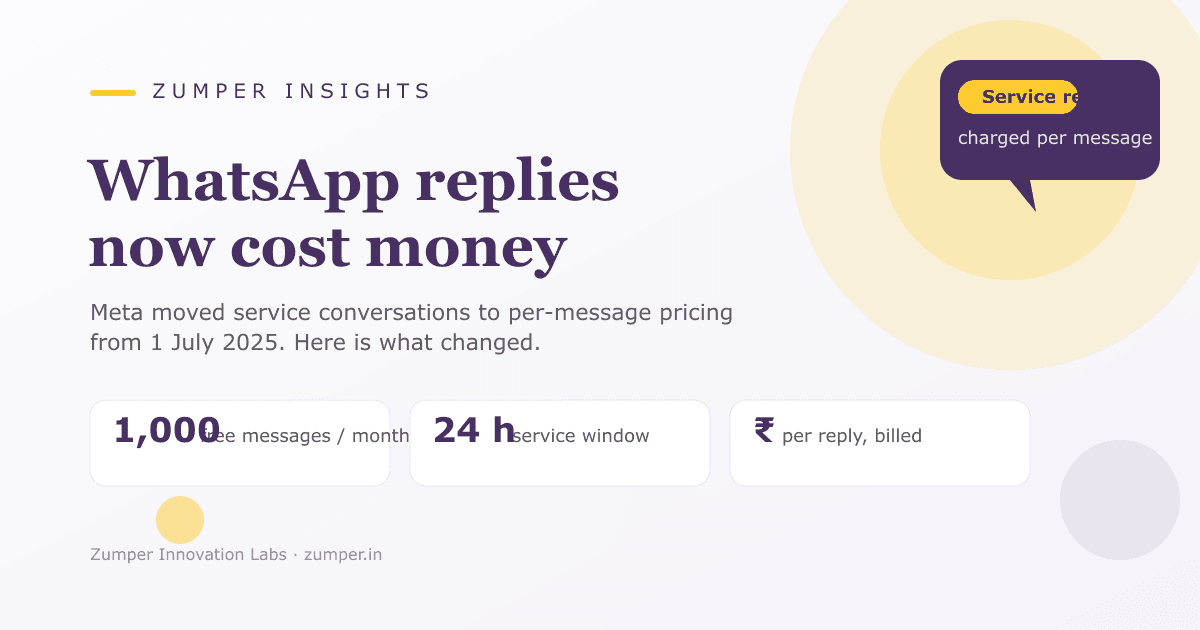
WhatsApp service replies changed from free to per-message pricing on 1 July 2025. Every business gets 1,000 free service messages a month; after that, messages are billed by conversation type and destination country. Plan which replies are automated to stay within the free tier.
At a glance · Key takeaways
- Meta moved WhatsApp from conversation-based to per-message pricing on 1 July 2025; service replies are inside that change.
- Each business phone number still gets 1,000 free service messages a month, and the allowance does not roll over.
- The 24-hour customer service window still exists, but it is no longer a free pass; it is a rule about what you may send.
- User-to-business messages are never charged, so inbound questions are not the cost. Your replies are.
What actually changed
WhatsApp replies are no longer free.
Meta moved WhatsApp Business from conversation-based pricing to per-message pricing on 1 July 2025. Under the old model you paid per 24-hour conversation. Under the current model you pay per message, by category, and only for messages that travel from your business to a user.
Service messages — the ordinary replies you send when someone asks a question — sit inside that billing model. The 24-hour customer service window still decides what you are allowed to send. It no longer decides what you pay.
If your volume is small, you may pay nothing at all: every business phone number gets 1,000 free service messages a month.
Which messages carry a charge
| Direction | Category | Billed by Meta |
|---|---|---|
| Business → user | Marketing | Yes |
| Business → user | Utility | Yes |
| Business → user | Authentication | Yes |
| Business → user | Service (a reply inside an open window) | Yes, after the free allowance |
| Business → user | Any of the four, inside a free entry point window | No |
| User → business | Any | No |
Two lines matter more than the rest.
User-to-business messages are free. When a customer opens the chat, that inbound message costs you nothing.
The free entry point window is free. Messages inside that window are not charged, which makes the entry point — a click-to-chat link, a QR code, an ad — the cheapest place to start a conversation.
The 1,000 free service messages
For each business phone number, Meta gives 1,000 free service messages per month. The allowance resets monthly and does not roll over, so unused messages are gone at the end of the month.
That single line decides whether a small clinic, school or studio pays anything at all. If you answer roughly 30 questions a day, you are probably inside the free tier. If you run support for an online store during a sale week, you are not.
The allowance is per phone number, not per team member, and not per inbox.
The 24-hour window is a rule, not a discount
Non-template messages — plain text, images, documents — can only be sent inside an open customer service window. That window opens when the user messages you and stays open for 24 hours.
Read that carefully, because the change is easy to misread. The window still governs permission. It no longer grants free service. A reply at hour 23 is as chargeable as a reply at minute 1, and the only thing that makes either free is the 1,000-message allowance or a free entry point.
Outside the window, you need an approved template, and templates are billed by their own category.
India is on the rate card
As of 1 October 2026, Meta's rate card covers 47 markets, and India is one of the named markets. Rates are set by category and market, which is why a figure quoted in a blog post six months ago is worth ignoring.
We deliberately do not print a per-message rupee rate here. Rates change, and a stale number in an article is worse than no number. Read the current India rate from Meta's own rate card before you model a budget.
What to check this week
- Count your replies, not your conversations. Pull last month's outbound service messages per phone number. That number, divided by what you send, tells you how close you are to 1,000.
- Separate the three jobs on one number. Marketing blasts, order updates and support replies on a single number share one allowance and one bill. Splitting them is usually cheaper and always easier to read.
- Move starters to a free entry point. A click-to-chat link or QR code that opens the window is both the cheapest path and the most trackable one.
- Stop sending templates where a reply would do. A template outside the window costs money and often reads worse than a human answer.
- Put the number on a report. If nobody owns the monthly message count, the first surprise arrives with the invoice.
Mistakes that cost money
- Treating the window as free. It is a rule about timing, not a price.
- Assuming inbound messages cost you. They do not.
- Burning the allowance on status pings. "Your order is packed" is a utility message and a separate category; keep it out of the support thread if you can.
- Letting one number carry every campaign. The allowance is shared, so a broadcast can starve the support replies that actually need it.
What to do next
Start with the number, not the tooling. Count your outbound service messages for one month, check it against 1,000, and you will know within ten minutes whether this change costs you anything at all.
If the answer is "we have no idea", that is the finding. A WhatsApp CRM that logs every outbound message by category turns the question into a report instead of a guess — and if you would rather test the demand side first, the free WhatsApp link generator builds a trackable click-to-chat link without a developer.
We build WhatsApp flows inside CRM and ERP projects for Indian businesses. Zumper Innovation Labs can audit the count before you change anything — talk to us. For the wider picture on search, ads and websites, the services page lists what we run.
References
- Meta, WhatsApp Business Platform pricing — https://developers.facebook.com/docs/whatsapp/pricing — read 31 October 2026. Source for per-message pricing from 1 July 2025, the 1,000 free service messages per month, the 24-hour customer service window, the free entry point window, and the 47-market rate card as of 1 October 2026.
Frequently asked questions
Are WhatsApp service replies free?
No. Meta has charged per message since 1 July 2025, and service replies are billed like the other categories. Each business phone number does get 1,000 free service messages a month, and messages inside a free entry point window are not charged.
Did this start in October 2026?
No. The move from conversation-based to per-message pricing took effect on 1 July 2025. 1 October 2026 is the date Meta's rate card covers 47 markets, India among them. Articles that date the pricing change to October 2026 have the wrong event.
Do messages from customers cost anything?
No. Meta charges only for messages a business sends to a user, so inbound questions are free. Your replies are what appear on the bill.
What happens to unused free messages?
They expire. The 1,000-message allowance resets each month and does not roll over to the next one.